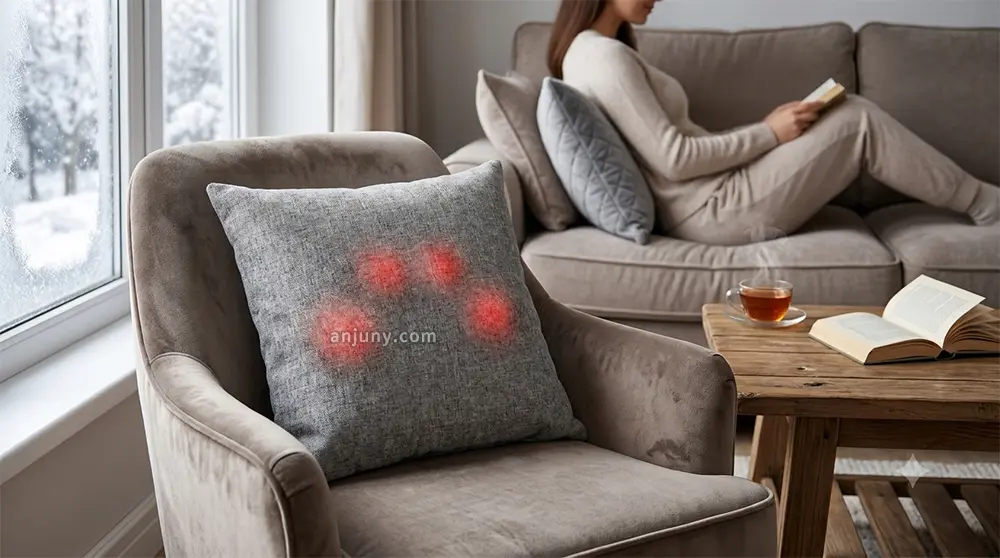
The global heated massage pillow market is entering a phase of channel diversification — traditional retail, e-commerce D2C, corporate wellness gifting, and automotive aftermarket all represent distinct procurement opportunities. However, not all heating pillows are built for multi-market distribution. A product that sells well via a single Amazon listing in the US may fail customs clearance in Germany due to plug incompatibility, or trigger high return rates in the UK because a non-washable cover develops odors after three weeks of use.
Three converging trends make the 2026-2027 procurement window particularly favorable for this category:
Remote and hybrid work is now structural, not temporary. Post-pandemic office attendance in North America and Europe has stabilized at roughly 50-60% of pre-2020 levels. This means consumers are investing in home comfort products with the same budget previously reserved for office ergonomics. A heating massage pillow sits at the intersection of "wellness" and "home office accessory" — two categories that showed compound annual growth of 8-12% over the past three years.
Energy-conscious heating is reshaping consumer behavior. With electricity prices in Europe rising 40-80% since 2021, consumers are shifting from whole-room heating to personal heating devices. A 45×45cm heating pillow drawing 5V DC power costs pennies per hour to operate. This "personal microclimate" logic is driving demand across Northern Europe, the UK, and Canada.
The gift market is the hidden multiplier. Corporate wellness programs, holiday gifting, and promotional merchandise represent a procurement channel that many B2B buyers overlook. A product with broad demographic appeal — elderly parents, office workers, drivers — and a moderate price point ($15-25 wholesale) fits standard corporate gifting budgets precisely.
Procurement takeaway : Enter this category with a product that works across at least three of these channels. A single-function, single-market SKU limits your negotiation leverage with suppliers and your shelf appeal with retailers.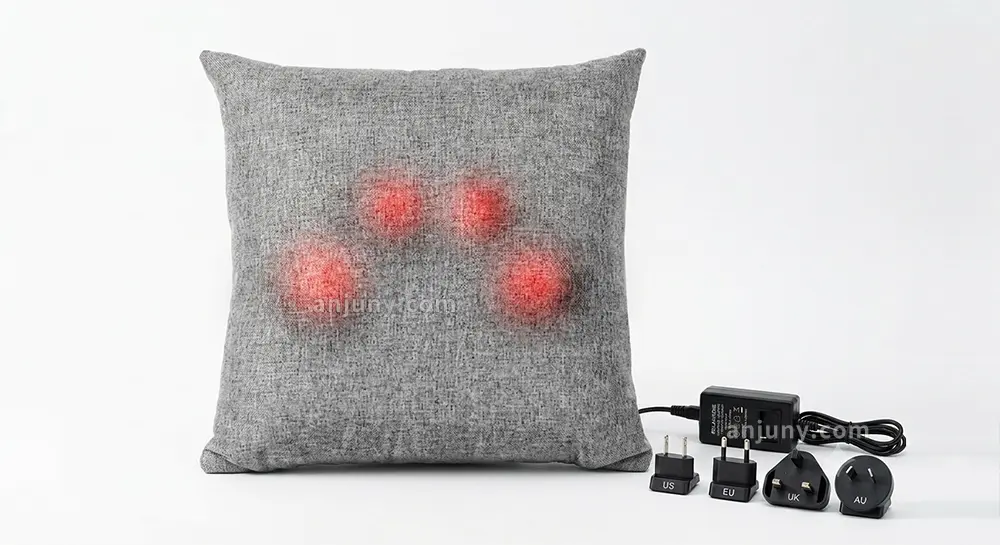
This is the single most misunderstood technical choice in the heating pillow category — and the one with the largest downstream impact on compliance cost, return rate, and per-unit margin.
|
Factor |
DC Powered |
|
Power source |
Wall outlet via adapter |
|
Battery certification |
Not required (no lithium cell) |
|
Shipping classification |
Non-hazardous, no UN38.3 testing |
|
Per-unit compliance cost |
~ |
|
Continuous runtime |
Unlimited (always plugged in) |
|
Heat consistency |
Stable, no voltage drop as "battery drains" |
|
Consumer complaint risk |
Low (no dead-battery returns) |
|
Factor |
Battery Powered |
|
Power source |
Rechargeable lithium cell or power bank |
|
Battery certification |
UN38.3 + MSDS + possibly UL 1642 required |
|
Shipping classification |
Class 9 dangerous goods for bulk air freight |
|
Per-unit compliance cost |
|
|
Continuous runtime |
2-4 hours typical, then recharge |
|
Heat consistency |
Drops as battery voltage declines |
|
Consumer complaint risk |
High — "won't turn on," "doesn't last long enough" |
The B2B math: For a 1,000-unit order, choosing DC over battery saves approximately 1,500-4,000 in battery certification and dangerous goods surcharges. For an annual 10,000-unit contract, that's 15,000-40,000 in avoidable compliance friction.
The consumer math: A DC pillow will never arrive dead, never degrade in heat output mid-session, and never require a replacement battery after 300 charge cycles. These are the exact failure modes that generate 1-star reviews and return requests.
Bottom line for buyers: Unless your primary sales channel specifically demands "cordless" as a headline feature (e.g., outdoor/camping retail), DC power is the lower-risk, higher-margin choice.
A procurement problem that costs distributors real money: ordering region-specific variants of the same product. A UK-bound SKU sits unsold while your European distributor runs out of stock — and the only difference is the plug on the power adapter.
The multi-country plug adapter solves this at the SKU level. Instead of maintaining four inventory lines, you stock one product with four interchangeable plug heads:
|
Plug Type |
Markets Covered |
Plug Standard |
|
US |
United States, Canada, Mexico, Japan, Taiwan |
Type A / Type B |
|
EU |
Germany, France, Italy, Spain, Netherlands, most of continental Europe |
Type C / Type F |
|
UK |
United Kingdom, Ireland, Hong Kong, Singapore, Malaysia, UAE |
Type G |
|
AU |
Australia, New Zealand, China, Argentina |
Type I |
One shipping carton serves four markets. This reduces minimum order fragmentation — instead of placing four 500-unit orders to meet four regional MOQs, you place one 2,000-unit order and allocate inventory by demand.
For private-label buyers the multi-plug adapter kit also simplifies packaging: one universal box design with a sticker indicating included plug types, rather than four separate printed boxes.
Products that do one thing well sell to a niche. Products that do two things well sell to a broader audience — and at a higher price point.
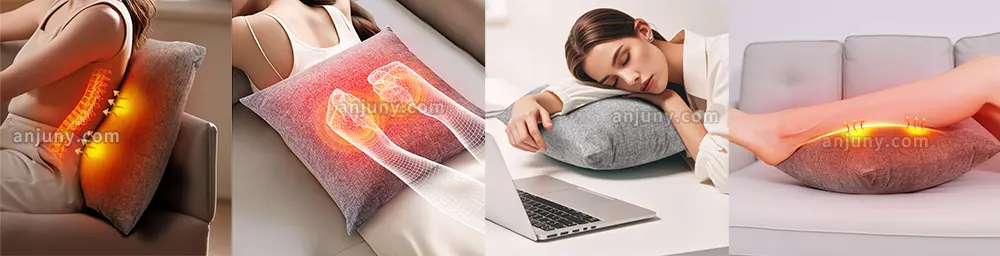
The heating massage pillow with vibration targets two distinct consumer needs in a single purchase decision:
|
Single Function |
Consumer Perception |
Willingness to Pay |
|
Heat only |
"A warm cushion" |
$15-25 retail |
|
Vibration only |
"A vibrating pillow" |
$12-20 retail |
|
Heat + Vibration |
"A personal massager" |
$25-40 retail |
The psychological jump from "cushion" to "massager" is what supports the higher price band. When a consumer sees "heat + vibration massage," they categorize the product alongside dedicated massage devices — not alongside throw pillows.
The B2B implication: A dual-function product occupies shelf space in two retail categories (home comfort AND personal wellness), doubling your potential retail partners. It also supports a higher wholesale markup — distributors can price a 2-in-1 product at 40-50% margin, compared to 25-30% for a single-function heated cushion.
Spec to verify when sourcing: Confirm whether vibration and heat operate independently. Some entry-level products force both functions on simultaneously, which limits the use case (the consumer can't use vibration alone in summer, or heat alone when sensitive to movement). Independent controls = broader seasonal demand.
A supplier listing "CE certified" tells you almost nothing — CE is a self-declaration for many product categories. What matters is which specific directives the CE mark covers, and which third-party certifications back it up.
|
Certification |
What It Covers |
Why It Matters for Customs |
|
CE |
EU electrical safety (LVD) + electromagnetic compatibility (EMC) directives |
Mandatory for EU entry. Without it, customs can seize and destroy the shipment |
|
RoHS |
Restriction of hazardous substances (lead, mercury, cadmium, etc.) in electrical components |
Required for CE compliance. Also increasingly required by Amazon EU for electronics listings |
|
ISO 9001 |
Factory quality management system — covers production consistency, not product safety |
Tells you the factory has repeatable processes. A supplier without ISO 9001 is a higher risk for batch-to-batch variation |
|
BSCI |
Social compliance audit — covers working conditions, wages, child labor |
Required by many European retail chains (Lidl, Aldi, Carrefour) before they'll onboard a new supplier |
Procurement rule: Never assume a supplier holds all certifications you need. Ask for the actual certificate number — not just the logo on a spec sheet — and verify it on the issuing body's public database. A supplier who can't produce a certificate number within 24 hours doesn't have the certification.
0.50 Feature That Prevents 5,000 in Returns Here's a scenario that plays out thousands of times per year in the heating pillow category:
A consumer buys a heated pillow, uses it daily for two weeks, and notices a slight odor from accumulated sweat and skin oils. The product description says nothing about cleaning. They try spot-cleaning, which leaves water stains. They return the product and leave a review: "Started smelling after two weeks, can't clean it."
The math for a distributor with 1,000 units sold: A conservative 3% odor-related return rate = 30 returns. At 25 average retail price, that's **750 in refunds**. Add return shipping (5/unit), restocking labor, and lost future sales from negative reviews — the real cost exceeds **5,000 per 1,000 units**.
A machine-washable plush cover that unzips for machine washing adds roughly 0.30-0.50 to the bill of materials. Over 1,000 units, that's 300-500 in added cost — against $5,000+ in avoidable losses.
When evaluating suppliers, ask these four questions:
A supplier who can answer all four questions affirmatively and provide test data is one who has thought through the full product lifecycle — not just the showroom moment.
The word "customizable" appears on nearly every B2B supplier's product page. What varies enormously is how deep that customization goes and how much it costs in time and MOQ.
|
Tier |
What You Can Change |
Typical MOQMOQ |
Lead Time Impact |
Best For |
|
Tier 1: Surface |
Color, logo placement, packaging design |
500-1,000 units |
+5-7 days |
Amazon private label, small brands |
|
Tier 2: Material |
Fabric type, thread color, zipper style, inner foam density |
1,000-2,000 units |
+10-15 days |
Mid-market brands, hotel chains |
|
Tier 3: Structural |
Heating element specification, PCB redesign, shell dimensions, plug configuration |
2,000-5,000 units |
+20-30 days |
Large retail chains, patented designs |
The supplier question that separates factories from trading companies: "Can I visit your production line and review the BOM (bill of materials) for the heating element?"
A factory-direct supplier can say yes and schedule it within a week. A trading company will deflect with "our partner factory" language. The difference matters because every middleman between you and the production line adds 8-15% to your unit cost and 3-5 days to your communication turnaround.
B2B buyers new to the heating pillow category often underestimate total procurement lead time. Here's a realistic timeline based on current (2026) supply chain conditions:
|
Phase |
Activity |
Duration |
Notes |
|
Week 1-2 |
Supplier evaluation, sample request, certification verification |
10-14 days |
Request physical samples — photos are not enough to evaluate fabric feel and heat distribution |
|
Week 3-4 |
Sample approval, order confirmation, deposit payment |
7-14 days |
Use this window to finalize packaging artwork |
|
Week 5-8 |
Production lead time |
20-30 days |
Standard for 1,000-5,000 units; add 10 days for Tier 2+ customization |
|
Week 9 |
Quality inspection (pre-shipment) |
2-3 days |
Third-party inspection recommended for first orders |
|
Week 10-14 |
Ocean freight (China → EU/US) |
25-35 days |
Sea freight is standard. Air freight cuts to 5-7 days but costs 3-5× more — only viable for small rush orders under 200 units |
|
Week 15 |
Customs clearance + last-mile delivery to warehouse |
5-7 days |
EU: allow extra 3 days for documentary checks. US: generally faster if HS code classification is correct |
Total: approximately 15-16 weeks from first inquiry to warehouse-ready inventory.
Critical timing note for seasonal buyers: If you're stocking for the Q4 winter/holiday season, your order should be confirmed by early August to ensure October arrival. Orders placed after September 1 typically arrive in November — leaving almost no buffer for customs delays or logistics disruptions.
To request product samples and a custom wholesale quote , contact Anjuny directly through the product page.
|
Standard |
Held |
Required Fo |
|
CE (EU Electrical Safety + EMC) |
✅ |
Mandatory for EU market entry |
|
RoHS (Hazardous Substances) |
✅ |
Required for CE compliance; Amazon EU electronics listings |
|
ISO 9001 (Quality Management) |
✅ |
Factory process consistency; required by many chain retailers |
|
BSCI (Social Compliance) |
✅ |
European retail onboarding (Lidl, Aldi, Carrefour, etc.) |
|
Spec |
Detail |
|
Product Name |
DC Powered Heating Massage Pillow |
|
Dimensions |
45 × 45 cm (±2 cm) |
|
Core Material |
Polyester fiber fill |
|
Cover Material |
Soft plush fabric, removable and machine washable |
|
Power |
DC powered via multi-country plug adapter (US/EU/UK/AU) |
|
Functions |
3 heating levels + vibration massage (independently controllable) |
|
Certifications |
CE, RoHS, ISO 9001, BSCI |
|
Color Options |
Grey (standard) / Custom colors available (OEM) |
|
OEM Services |
Custom logo, color, packaging design |
|
Target Channels |
Retail, e-commerce, corporate gifting, automotive aftermarket |
Last updated: August 8, 2026. Product specifications and certifications are subject to change. Always verify current certification status with the supplier before placing an order.

